
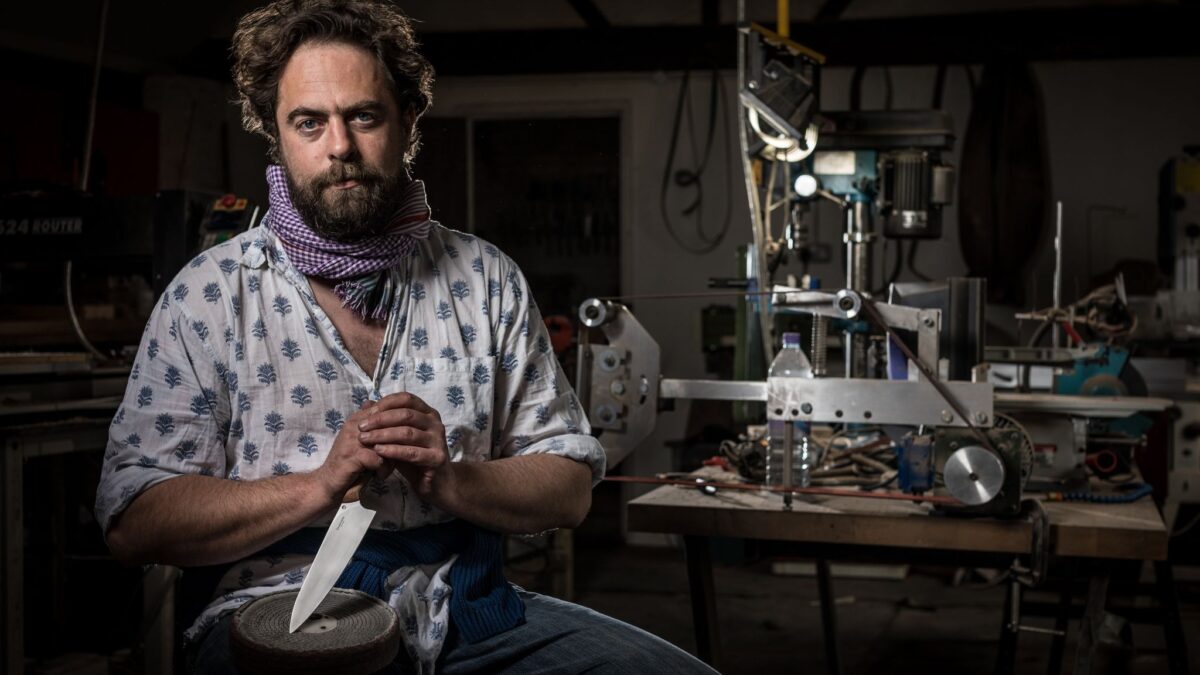
Savernake Knives marks 10 years of making kitchen knives to order in a Wiltshire sawmill. Here is where keen cooks can start and how to care for a blade.
A good knife changes how cooking feels. An onion falls into even slices, a squash gives way without a struggle, and the board work that once felt like a chore becomes the calm part of making supper. In a converted 1854 sawmill on the edge of Savernake Forest, near Marlborough, a team of 10 makers has spent a decade building knives with that in mind, each one made for the cook who will use it.
Savernake Knives was founded in 2016 by Laurie Timpson, who taught himself to make a single knife. The workshop now makes thousands a year for home cooks, professional chefs, hotels and restaurants. Every knife is made in-house, from raw steel to finished edge.
Which knife does what
Savernake’s most popular knives appear in almost every set the workshop has made. They are available for next working day dispatch with complimentary engraving.
- The Classic, £335: an 18cm European chef’s knife, the everyday workhorse of the kitchen.
- The Savernake Knife, £360: an 18cm nakiri, a mid-sized vegetable knife made for precise chopping.
- The Gyuto, £350: a 20cm Japanese-style chef’s knife for everything from slicing to dicing.
- The Stout Yeoman, £280: an 11cm utility knife for smaller tasks, with the 8cm LJ Paring Knife at £180.
For the table, the Woods of Savernake steak knife sets cost £500 to £2,400 and come in a green suede wrap.
What makes the blade different
Each blade is cut, hardened and hand-finished with Savernake’s signature concave grind, which leaves the steel very thin behind the cutting edge. Most are made from a Swedish stainless steel, hardened to 60 HRC and sharpened to a 15 degree edge. The knives rank in the top 2.5% of those tested by CATRA, the Cutlery and Allied Trades Research Association, and carry a lifetime guarantee against manufacturing faults.
Design your own
Cooks who want something of their own can use the online configurator, which offers 18 blade designs, 16 handle materials and nine liner colours. Handles range from bold composites to woods, including British native species. Custom knives start at £250 and take around a month. A fully bespoke knife, drawn from scratch, starts at £1,250 and takes 8 to 12 weeks.
The makers
The team knows kitchens from the inside. Jack spent around 20 years as a chef before joining. Martyn, who leads finishing, spent more than four decades in fine furniture, and Tiffany, a master saddler, hand-stitches the leather sheaths and knife rolls. Savernake has collaborated with chefs Tom Aikens, Mark Sargeant and Daniel Galmiche, and for the centenary of Quo Vadis, chef patron Jeremy Lee hand-drew the knife shapes himself.
Timpson, a former Scots Guards officer who cleared landmines with the HALO Trust, still designs every knife in the range. “Ten years ago, Savernake was me, a mill and a knife design in my mind that I just couldn’t find anywhere,” he says. “Today it’s a team of ten brilliant makers, and I’m incredibly proud of what we’ve built together.”
How to look after a good knife
The workshop’s own advice is brief.
- Wash by hand: scrub, rinse and dry. The dishwasher damages the handle and dulls the edge.
- Choose the right board: wood or good plastic. Glass and slate will ruin the edge.
- Store it properly: a rack, magnetic strip or block, never loose in a drawer.
- Hone little and often: honing realigns the edge, while sharpening removes steel to make a new one.
- Send it back for sharpening: Savernake resharpens its own knives, asking only £10 for return postage in the first three years.
Need to know
Knives are ordered online and delivered by tracked post. Custom designs take around a month, so Christmas orders are worth placing early. Buyers must be over 18, with age checked at purchase and on delivery. The workshop does not run knife-making courses, and visits are by appointment for those buying a knife.

Comments