
Every diner out in London knows the small, private anxiety of the walk to the table. You have booked the right restaurant. You have arrived on time. And then the maître d’ picks up two menus and you find out, in front of the person you are trying to impress, exactly what the room thinks of you.
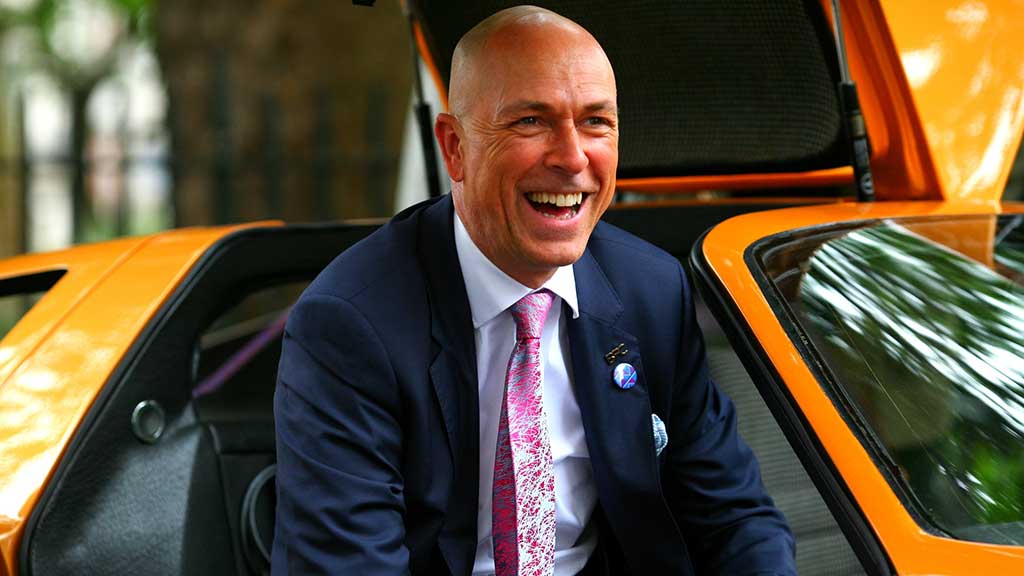
Dylan Jones has spent most of his adult life on the right side of that walk. As editor of British GQ from 1999 to 2021 he was, by his own account, in the Art Deco dining room of Le Caprice behind The Ritz several times a week, hosting designers, advertisers, film stars and the occasional supermodel who turned up almost an hour late and left him with the bill. He knows which tables matter and which are Siberia. He has also, it emerges, been keeping notes.
The result is Table Hopping: The Secret History of London Restaurants, from Langan’s Brasserie to the Wolseley, published this month by Little, Brown. It is an oral history built from more than 100 interviews gathered over 18 months, and it does for the London dining room what his earlier books did for David Bowie, the New Romantics and Britpop. It lets the people who were there tell the story, and then stands back while they incriminate themselves.
Half a century since Langan’s
The timing is no accident. It is 50 years this month since Peter Langan, Michael Caine and the chef Richard Shepherd opened Langan’s Brasserie on Stratton Street in Mayfair in October 1976. Jones takes that as his starting gun, the moment a London restaurant stopped being somewhere you went to be fed and became somewhere you went to be seen.
Before Langan’s, the city’s grand dining rooms were largely French, formal and hushed. After it came noise, art on the walls, paparazzi on the pavement and a proprietor whose own behaviour was frequently more newsworthy than anything his customers got up to. From there the book moves through Joe Allen, Le Caprice and L’Escargot, on to Kensington Place, Harveys, The Ivy, Quaglino’s and the Atlantic Bar & Grill, and ends at The Wolseley on Piccadilly, the grand café that Chris Corbin and Jeremy King opened in 2003.
The argument running underneath is a big one for anyone who travels for work. In those five decades, Jones contends, London went from a culinary punchline to a city that out-eats Paris and New York, what he calls the global culinary petri dish. Business visitors once tolerated eating in London. Now they plan trips around it.
When the dining room was the story
What Jones did not expect, he admits, was quite how much of his research would have nothing to do with food at all. The more people he interviewed, the more the same theme surfaced: for those who were there, and even more for those who were not, the 1980s and 1990s are remembered as the peak of the London restaurant, a period when the city was awash with money, fame and very few inhibitions.
The stories he has collected are, to put it in language suitable for a business travel magazine, vivid. Lavatories, cloakrooms, bars and, on more than one occasion, the dining room itself all feature as venues for behaviour that had little to do with the menu. One restaurateur recalls being summoned by a security guard late on a Thursday night to deal with a pinstriped City type and his date, who had abandoned all pretence of discretion at a table by the bar while 50 other diners looked on. His verdict was to shrug and let them get on with it, since nobody appeared to be complaining.
Jones’s explanation for all this is a shrewd one. It was the decade of Britpop, the Young British Artists, New Labour and Trainspotting, and it was also the last decade before the camera phone. Whatever happened in Soho on a Wednesday night, there was a reasonable chance that nobody would ever be able to prove it. The tabloid editors of the period tell him the same thing from the other side of the velvet rope: famous people let their guard down in restaurants and clubs in a way that would be unthinkable today, and the gossip columns filled themselves.
It is a useful thought for the modern executive at a client dinner. Every table is now, potentially, on the record.
The Atlantic, just off Piccadilly Circus
If the book has a single location that stands for the whole era, it is the Atlantic Bar & Grill, which the Irish restaurateur Oliver Peyton opened in 1994 in a vast basement ballroom off Piccadilly Circus. It was, at the time, the biggest restaurant in London, it had a late licence, and for a few years it was almost impossible to get into.
The guest list Jones reels off is a roll call of the decade: rock stars, film directors, supermodels, comedians and artists. Peyton remembers Bill Murray standing unrecognised at reception in tracksuit bottoms, famous faces settling in at six in the evening with a book, and leaving two well-known drinkers at the bar at teatime one day only to find them in the same seats when he came back 24 hours later. He also recalls offering to walk Alexander McQueen past the queue, lifting the rope himself and being stopped by his own doorman, who wanted to know where he thought he was going.
The room is still there. It is now Brasserie Zédel, and the streets above it have changed almost beyond recognition, with Moxy’s 532-room flagship at Piccadilly Circus the latest sign that this corner of the West End has swapped late licences for lifestyle hotels. Visitors checking in today will find it hard to believe what used to go on beneath their feet.
The power of the room
For Jones himself, the restaurant that mattered most was Le Caprice. Corbin and King had relaunched it on Arlington Street in 1981, and by the time he arrived at GQ it was the unofficial canteen of Condé Nast, the place where magazine people took the people they needed something from.
His memories of it are those of a man who was working, not merely eating. There was the lunch at which his publishing director bet a senior department store executive that she could not remove a particular item of underwear without taking off her shirt, a wager she won by a method he says he has never worked out. There was the afternoon he was quietly photographed across the table from a woman then at the centre of a political scandal. And there was Jesus Adorno, the restaurant’s celebrated maître d’, who on seeing the editor Tina Brown walk in unannounced produced a table from nowhere in what Jones swears was about a minute and a half.
That last story is the one that explains the book’s title. Jones has argued elsewhere that where you sit is the single most important thing about a really good restaurant, and that only a handful of London dining rooms still make it matter: Scott’s on Mount Street, the River Café, The Wolseley, Colbert on Sloane Square and Wiltons on Jermyn Street, where he says a booth is essential. Being shown to the table once favoured by Diana, Princess of Wales at Le Caprice was, for him and for his contemporaries, the moment you knew you had arrived.
Anyone who entertains for a living will recognise the instinct. It is also why The Ivy, which Corbin and King bought in 1989 and relaunched the following year, became the most important lunch in town. Jones describes it as a members’ club without a membership list: simply securing a table put you in the first division, even if you were then seated by the far wall.
Alex James of Blur gives him the definitive Ivy anecdote. In the summer of 1998 he sat down to lunch at one o’clock with Damien Hirst and Keith Allen to celebrate a vast advance order for their World Cup single. Eight hours later they were still there, with a bill running to thousands of pounds, almost all of it drink. A famous England footballer and his pop star fiancée came in for dinner and were shown to a perfectly good table. The best one in the room, however, was being held for Harold Pinter. James tells Jones it was “peak Nineties”, and it is hard to disagree.
Chefs, critics and the art of throwing people out
The other great cast of characters in Table Hopping is the chefs, and above all Marco Pierre White, who opened Harveys on Wandsworth Common in 1987 and promptly became as well known for ejecting customers as for feeding them.
Asked about it now, White is unrepentant, and his defence will strike a chord with anyone who has had a quiet working dinner ruined by the table next door. His line was simple, he tells Jones. If a party of deal-makers celebrating too loudly would not pipe down when asked, they went. If anyone was rude to his staff, they went faster. The critic Fay Maschler, who reviewed him for the Evening Standard, admits the constant possibility of an eruption was part of the thrill of eating there.
Feuds run through the book like a seam. Gordon Ramsay relives the night he asked the Sunday Times critic AA Gill to leave his restaurant mid-meal, having decided he had taken quite enough unkind copy from him. And the staff get their revenge too. At Kensington Place, the glass-fronted Notting Hill restaurant that also opened in 1987, a waitress who had been finger-clicked at once too often by an overbearing customer delivered a reply so withering, and so unprintable, that it has been repeated in London kitchens ever since.
It is a reminder that the rules of the business dinner have not changed much in 40 years. Be on time, keep your voice down and, above all, be civil to the people bringing you your food. They have long memories, and some of them have now been interviewed.
What remains
So where does all this leave London in 2026? Tamer, certainly. Jones closes his research with a scene at Wimbledon, where he asked the editor of Tatler, seated beside him in a hospitality suite, whether he had ever misbehaved in a restaurant in the way the previous generation apparently did as a matter of routine. The answer was a proud no. He was, he said, “too vanilla”.
Many of the rooms themselves have gone or changed hands. The original Le Caprice closed in 2020, though King has since reopened the site as Arlington. Langan’s has new owners. The Ivy is now a national brand. And The Wolseley, the book’s end point, has become an export, with a Wolseley members’ club due to open in New York in 2027.
Yet the thing Jones is really writing about has survived. London remains a city where deals are done over lunch, where the choice of restaurant says as much as the pitch, and where a good maître d’ can make or break an afternoon. The hedonism may have moved on, but the theatre has not.
Table manners for the casual diner
What, then, should the reader with a client or beau to impress take from Table Hopping? First, that the room matters as much as the menu, so choose one that suits the conversation you need to have. Secondly, that a relationship with the person on the door is worth more than any booking app. Thirdly, that the long lunch is an endangered pleasure worth defending, within reason and within the expenses policy. And finally, that in an age when every phone is a camera, discretion is no longer the restaurant’s job but yours.
For those planning their next visit to the capital, our guide to the best business restaurants in London is a good place to start. After reading Jones’s book you will never look at a corner table in quite the same way again.
Table Hopping: The Secret History of London Restaurants, from Langan’s Brasserie to the Wolseley by Dylan Jones is published by Little, Brown and is available in hardback from Waterstones, £30

Comments