
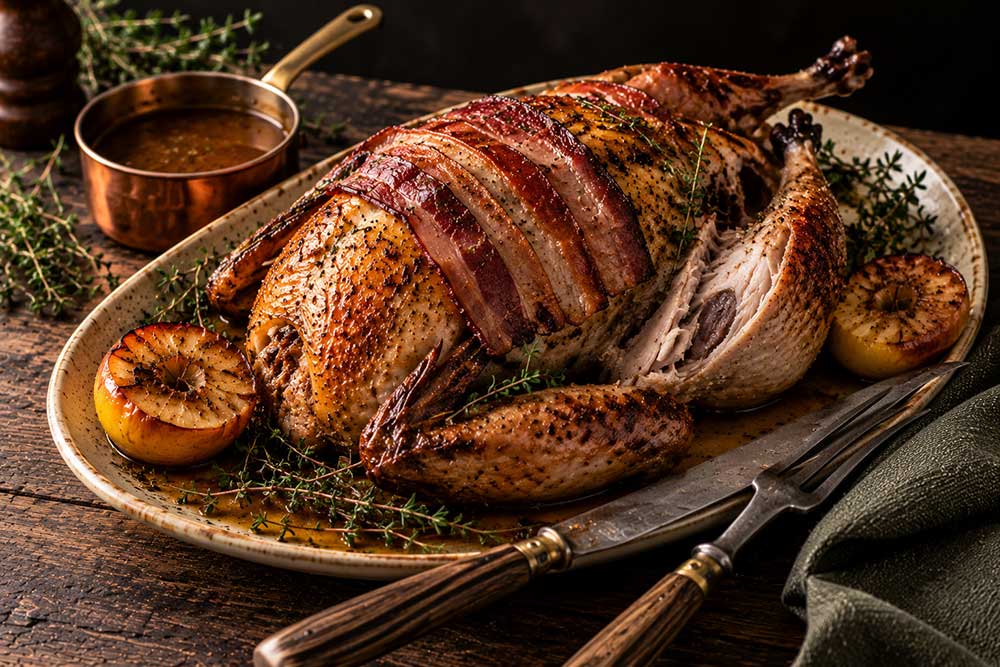
Every October the butcher’s window changes. A brace of pheasant appears where the chicken usually sits, priced at less than a supermarket free-range bird, and most people walk straight past it. Game is the last genuinely seasonal meat in Britain, it is often the cheapest thing in the shop, and it has a reputation for being difficult that it does not deserve.
Here is what you need to know before you buy your first bird.
When game is in season
Game arrives on a timetable set by law rather than by the weather. The Game and Wildlife Conservation Trust gives the open season for pheasant in England, Wales and Scotland as 1 October to 1 February. Partridge starts earlier, on 1 September, and runs to the same date. Red grouse, the first and priciest of the year, runs from 12 August to 10 December. Wild venison is around for most of the year, because the seasons differ by deer species and by sex.
In practice that means October and November are the best weeks to start. Supply is high, prices are at their lowest, and everything that pairs with game is in the shops at the same time: apples, pears, quince, blackberries, wild mushrooms, celeriac, kale. It is also the cheapest time of year to pick up a mixed bag of birds, which is exactly what a traditional hot water crust game pie is for.
What to buy, and what to ask for
Ask for oven-ready. A good butcher or game dealer will have plucked, drawn and hung the bird already, and hanging is what turns game from bland to savoury. If you are buying from a farm shop or a market, ask how long it was hung. A week to ten days for pheasant is normal.
Start with one of these four.
Pheasant. The obvious beginner’s bird. One feeds two people. Think of it as a very lean chicken with more flavour and less patience for overcooking.
Partridge. Smaller, milder, sweeter. One bird per person. Roasts in about 20 minutes, which makes it a weeknight option rather than a project.
Venison. The easiest of all if you already cook beef. Haunch steaks and loin behave like sirloin. Shoulder and shin behave like shin of beef and want a long, slow braise.
Wood pigeon. The cheapest and the strongest flavoured. Breasts only, seared hard and rested, sliced over a salad of bitter leaves.
The one rule
Game is lean. That single fact explains almost everything about cooking it, and almost every disappointing game dinner comes from ignoring it.
A chicken bastes itself as it roasts. A pheasant has no such reserves, so you have to supply the fat and the moisture yourself. That means butter under the skin, bacon or pancetta laid over the breast, and a splash of stock, cider or wine in the tin. It also means you have two choices, and no useful middle ground.
Roast it fast and rest it long. A pheasant at 200°C/180°C fan/gas 6 for around 45 minutes, breast covered, then rested for 15 minutes under foil. Partridge, the same heat for around 20 minutes. Resting is not optional with lean meat: it is where the juices go back where they belong.
Or braise it slow. Brown the bird or the joint hard, then cook it submerged in stock and aromatics at 150°C/130°C fan/gas 2 until the meat pulls away from the bone. Older birds, later-season birds and anything you are unsure about should all go this way. Pearl barley, cider, bacon and root vegetables are the classic company, and our braised pheasant with whisky sauce and pearl barley pilaf is the route to take if you want the method spelled out.
What does not work is a cautious middle temperature for an unspecified time. Pick one route and commit to it.
Cooking it safely
Venison is a red meat and can be served pink, in the same way as beef. Game birds should be cooked through, following Food Standards Agency guidance for poultry and game birds: hot right through, with juices running clear.
On shot, the Food Standards Agency advises that people who eat lead-shot game frequently should minimise the amount they eat, especially small game, and notes that this is particularly important for toddlers, children, pregnant women and women trying for a baby. Occasional eaters are not the concern here, but it is worth knowing, and worth asking your supplier what the birds were shot with, since lead-free alternatives are increasingly common.
Feel for shot as you carve. It happens.
What to serve with it
Game wants three things on the plate with it: something sweet, something sharp and something earthy. Roast apples or a spoonful of quince cheese for the first. Pickled blackberries, redcurrant jelly or a splash of cider vinegar in the pan juices for the second. Celeriac mash, buttered kale, pearl barley or wild mushrooms for the third.
Get those three in place and the bird does not need much else. Which is, in the end, the point of game: it is a lean, cheap, deeply seasonal meat that asks for a little fat, a little acidity and a lot less fuss than its reputation suggests.
Game: your questions answered
When does the game season start in the UK?
The Game and Wildlife Conservation Trust gives the open season for pheasant in England, Wales and Scotland as 1 October to 1 February. Partridge runs from 1 September to 1 February, and red grouse from 12 August to 10 December. Wild venison is available for most of the year, as different deer species have different seasons.
What does game taste like?
Deeper and more savoury than farmed meat, with less fat. Pheasant sits close to a well-flavoured free-range chicken. Partridge is milder and sweeter. Venison tastes like lean beef with a mineral edge. Wood pigeon is the strongest of the four.
Is game healthy?
Game is leaner than most farmed meat. The Food Standards Agency advises that people who eat lead-shot game frequently should minimise the amount, especially small game, and says this is particularly important for toddlers, children, pregnant women and women trying for a baby.
Can you cook game rare?
Venison can be served pink, like beef. Game birds should be cooked through, following Food Standards Agency guidance for poultry and game birds.

Comments