
Every traveller who has spent any time in Italy knows the moment. The meeting runs long, the client suggests lunch, and suddenly you are seated at a table that was not booked, in a trattoria you would never have found on your own, eating something so simple and so good that you spend the rest of the trip trying to work out how they did it.
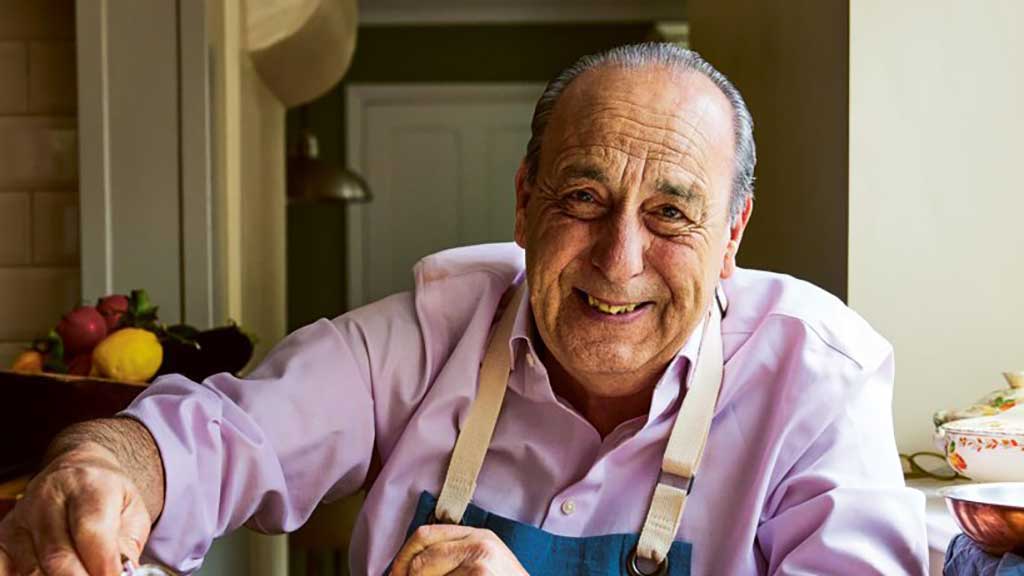
Gennaro Contaldo has spent his entire working life explaining how they did it. Born in Minori on the Amalfi Coast in 1949, he arrived in England in 1969, worked his way through London’s kitchens, cooked at Antonio Carluccio’s Neal Street Restaurant in Covent Garden, where a young Jamie Oliver came under his wing, and opened his own restaurant, Passione, on Charlotte Street in 1999. Since then there have been television series, including the BBC’s Two Greedy Italians alongside his late friend Carluccio, a long run of cookbooks and, more recently, a huge social media following for a man who turns 78 in January and still cooks with the energy of a teenager.
Italy has recognised him too. He holds the Order of the Star of Italy, and for years he has been described, only half jokingly, as the nation’s unofficial ambassador for its food in Britain.
With an updated edition of Slow, his book on Italian slow cooking, on the shelves, we caught up with him to talk about home, memory and why the best Italian cooking is nearly always the simplest.
A peninsula between two seas
Ask Contaldo why the world is so enchanted with Italy and the answer arrives in a single breath, as if he has been waiting all his life to be asked.
“Italy is a beautiful peninsula,” he says. “It’s in the middle of two seas, the Adriatic and the Tyrrhenian, the mountains are full of snow and forest, the coastline is spectacular and the air is good. In all the regions, people are attached to the land. Italy is like a museum full of history, emotion and culture. And we’re so inventive… I’m Italian, so I would say that!”
It is a neat summary of why the country keeps pulling in visitors of every kind, from the conference delegate in Milan to the family on a fortnight in Puglia. Italy is not one destination but 20 regions, each with its own dialect, landscape and, crucially, its own table. For the business traveller, that attachment to the land is the gift. Order what the region is known for, and you will rarely go wrong.
Fish, chips and freedom in Tooting Bec
Before Passione, before television and before the cookbooks, there was a fish and chip shop in south London.
“When I first came to England, I worked in a fish and chip restaurant in Tooting Bec,” he says. “I’d been in the kitchen since I was about 10, but I had to get used to the fish being cooked in a strange way; the chips, my goodness, and then you’d have a cup of tea with it!”
For a young man raised on fish pulled from the Tyrrhenian that morning and cooked with nothing more than olive oil, lemon and a little parsley, battered cod with a mug of builder’s tea must have been something of a culture shock. Yet there is no disdain in the way he tells the story, only affection.
“But I loved England from the minute I arrived,” he says. “I was young, adventurous. There were The Beatles, The Rolling Stones, freedom from your mum and dad. You could be yourself.”
It is a reminder that plenty of the people who have shaped British food over the past 50 years arrived as young outsiders with very little, and that London’s kitchens have long been where new arrivals find their feet. Anyone who has taken a job overseas early in their career will recognise the mixture of bewilderment and exhilaration. You do not always understand the food, but you love the freedom.
The noble simplicity of cucina povera
So what makes Italian cooking so distinctive, and so revered around the world? For Contaldo, it comes back to a phrase that every Italian grandmother understands.
“Italian food is simple,” he says. “It’s the ‘cucina povera’, which sometimes means you can’t afford too much, but it also means simple, noble ingredients. You could pick dandelion leaves and that would make a great salad.”
Cucina povera, literally “poor cooking”, is the peasant tradition of making something delicious from whatever the land, the sea and the store cupboard provide. Stale bread becomes panzanella or ribollita, a handful of beans becomes a meal, wild greens gathered from the roadside become a side dish. It is a philosophy rather than a recipe book, and it relies above all on the seasons.
“Everything in season tastes good,” he says. “These days, of course, you can buy anything all year. But imagine eating cherries at Christmas! I like to wait, then you get that special feeling, the happiness and the memory.”
It is an idea worth taking on the road. Supermarkets and hotel buffets may offer strawberries in February, but the traveller who eats what is in season locally, whether that is white asparagus in Germany in spring or porcini in Piedmont in autumn, will eat better and remember it for longer.
Minori, the city of taste
Contaldo grew up in Minori, a small seaside village tucked between Amalfi and Maiori on one of the most celebrated stretches of coastline in the world, recognised by UNESCO when it inscribed the Costiera Amalfitana as a World Heritage Site in 1997. Like many people raised somewhere beautiful, he took it for granted.
“I grew up in Minori, on the beautiful Amalfi coast,” he says. “I only realised how stunning it was after three years away. The freshness of the ingredients, buying food in season, the incredible fish… The sea became my swimming pool again. I go back a lot now.”
Minori is smaller and quieter than Positano or Amalfi itself, and it has a reputation that suits its most famous son. Italy’s official tourism board describes Minori as the “City of Taste”, thanks to its pastry shops, its lemon groves and its long tradition of pasta making. The Sentiero dei Limoni, the Path of the Lemons, winds from the village through terraced groves to neighbouring Maiori, and the ruins of a first-century Roman villa sit just back from the seafront.
His most striking memory of the place, though, is of his father.
“My father could tell the difference between anchovies fished 200 metres from the shore and from two miles out,” he says. “It took me years to appreciate that.”
It is a remarkable line, and a perfect illustration of what food knowledge means in a place like Minori. It is not learned from books. It is handed down, at the harbour and the kitchen table, until it becomes instinct.
Getting to that coastline is easier than it used to be. Visitors once had to fly into Naples and piece together trains, buses and ferries, but the long-awaited reopening of Salerno Costa d’Amalfi Airport has put the region within much closer reach, with the airport just 45km from Amalfi. New hotels are following, including Hilton’s Majestic Palace in Sant’Agnello near Sorrento, due in spring 2027 with a Michelin-starred restaurant.
Coming home to Santa Trofimena
For all his years in Britain, the pull of home remains strong, and he has a ritual whenever he returns.
“When I go back to Italy, the first thing I do is go to the saint of my village, Santa Trofimena,” he says. “I’m quite religious and respect all religions around the world. I stop by the church first, then I feel like I’m home.”
The Basilica of Santa Trofimena, which sits just back from the beach and houses the relics of the village’s patron saint, is the heart of Minori, and a first stop for many returning locals. Then comes the reception that only a small village can give.
“The village is quite small, so there’s lots of, ‘Hello Gennaro, how are you?'”
Most frequent travellers have some version of this ritual, whether it is a particular pint in the local after a long-haul flight, a walk along a familiar stretch of beach or simply putting the kettle on. It is the thing that tells you the trip is over and you are back where you belong. For Contaldo, it is a quiet moment in a seaside basilica before the greetings begin.
The ragù he can never recreate
Every great cook has a dish they cannot match, and for Contaldo it is his aunt’s Sunday ragù.
“My aunt Maria used to make amazing ragù,” he says. “It was cooked slowly, slowly, slowly. I’ve tried to do that ragù so many times, but I realised I couldn’t get the flavour because it was the moment.”
He paints the scene with a storyteller’s eye.
“Seated with 25 members of the family, including a cat and a dog, around a table, the ragù on a massive plate in the middle, the smell, the adults saying, ‘Sit properly’… I make good ragù but I can’t recapture that moment.”
It is perhaps the most honest thing a chef can admit. Taste is bound up with place, company and memory, and no recipe can reproduce the noise of a family lunch on the Amalfi Coast. Anyone who has tried to recreate a holiday dish at home, or ordered a favourite meal from a trip in a London restaurant, will know the feeling. The food may be excellent, but it is never quite the same.
The art of cooking slowly
That patience, “slowly, slowly, slowly”, runs through Slow, the book in which he gathers the braises, soups, one-pot dishes and long-cooked roasts of Italian home cooking. The updated edition, published by HarperCollins, adds new photography, new vegan recipes and guidance on converting oven recipes for the slow cooker, with a focus on economical ingredients such as beans, root vegetables and cheaper cuts of meat.
“Slow cooking is very Italian,” he says. So is there a dish that tends to surprise people? He picks the artichoke.
“Dig the inside out and fill with anchovies, capers, tomato, breadcrumbs, then drizzle with olive oil,” he says. “Put the artichokes in a pot with a stock of carrots, potato, onions and celery, and cook for at least 35 minutes. Pull a leaf and if it comes out easily, it’s ready. You can have it as soup first, then eat the artichoke with a squeeze of lemon. Unbelievable!”
It is cucina povera in a single pot. A few cheap vegetables become a broth, the artichoke becomes the main event and nothing goes to waste. It is also the kind of dish that suits the returning traveller perfectly: put it on, unpack the suitcase, answer the emails and sit down to something restorative that has more or less cooked itself.
An ambassador at every stove
Contaldo has been called the ambassador of Italian food in Britain so many times that it has become part of his name. He is proud of the title, but characteristically keen to share it.
“I’m proud to have been given the title of ambassador for Italian food,” he says. “But every Italian who cooks is an ambassador. Many incredible unknown chefs and cooks have given me knowledge and I’m grateful for that.”
It is a generous answer from a man who has done more than most to change how Britain eats. When he arrived in 1969, Italian food in this country largely meant spaghetti bolognese and chianti bottles in straw baskets. Today London has some of the best Italian cooking outside Italy, from neighbourhood trattorias to grand City dining rooms, such as the recently opened Amalfi Ristorante near St Paul’s, which brings the flavours of the southern Italian coast to the Square Mile. Contaldo, and the unknown cooks he credits, are a large part of the reason why.
Italy is everything
Finally, why is food so central to the Italian way of life? The answer comes with the same infectious enthusiasm that has made him such a natural on screen.
“Italians express themselves through food,” he says. “Mangia, mangia! Eat, eat! Enjoy the sun. Be happy. This is what Italy is, it’s not just a glass of wine and ice cream. Italy is everything.”
Eating like gennaro on the road
So what can the average traveller learn from Gennaro Contaldo? Eat with the seasons, and be patient enough to wait for the good things. Order what the region is known for, and ask where the fish came from. Remember that the best meals are often the simplest, and that the company at the table matters as much as what is on it.
And if your work takes you to Campania, find time to take the coast road to Minori. Walk the Path of the Lemons, stop at the basilica, eat something slowly cooked and see if you can taste the difference between an anchovy caught 200 metres from the shore and one caught two miles out. Contaldo’s father could. It took his son years to understand why that mattered.
Slow by Gennaro Contaldo is published in hardback by HarperCollins, £22



Comments