
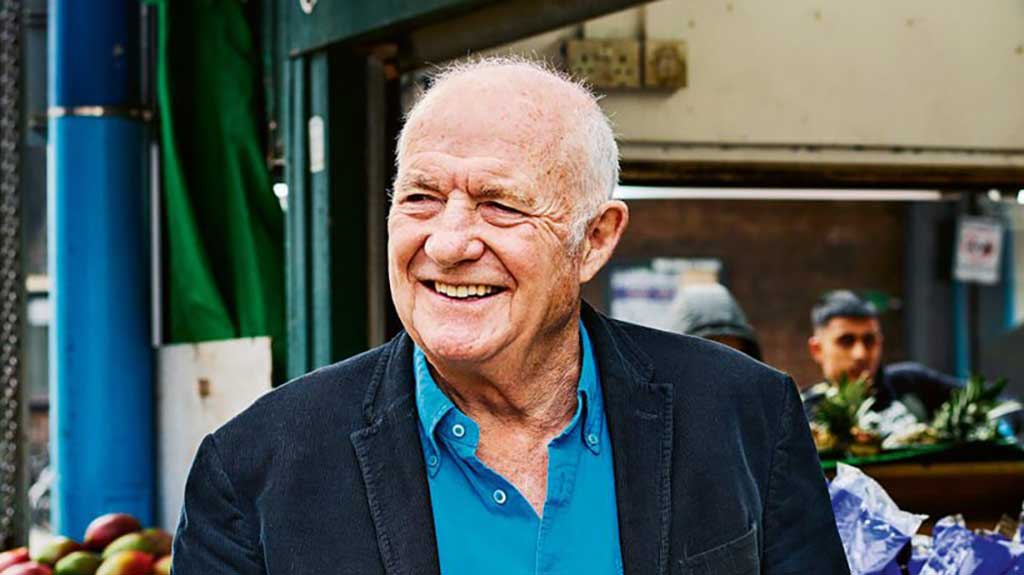
Few people have done more to change the way Britain eats than Rick Stein, and fewer still have done it by getting on a plane. For decades his television series have followed a simple formula: go somewhere interesting, find out what the locals eat, cook it, then bring the best of it home to Padstow.
The results are on the menu at The Seafood Restaurant, which Stein opened on the harbour in 1975 with his first wife, Jill, in a building that had previously been his nightclub. Half a century later, it is the flagship of a group that runs ten restaurants, cafés and bars across the UK, from Padstow to Barnes and Winchester, plus restaurants in Australia.
The restaurant marked its 50th anniversary in 2025 with a “Taste of 50 Years” menu revisiting dishes from across the decades and an anniversary cookbook. We caught up with the man himself to talk seafood, discos and the meals that have stayed with him.
The travelling notebook
A man who has eaten his way around the world for a living must have a system for remembering it all. So how does he keep track of his foodie memories when he is off duty?
“I’ve got into the habit of taking pictures, I almost snap everything I eat apart from when I’m at home,” he says. “Everybody used to think it was very poor, bad manners, but because everybody does it now, nobody cares.”
On the road, it has always been pen and paper. “When I’ve been filming, I’ve always just written down what I’ve eaten. I’ve got a drawer full of old notebooks.”
It is a habit worth borrowing. Most business travellers can recall the deal they closed on a trip, but far fewer can remember the brilliant little restaurant they found round the corner from the hotel. A quick photograph and a line in a notebook costs nothing and makes every trip richer.
Still hunting the Fugu
Stein did more than anyone to wean the British off cod and chips and on to the full range of fish and shellfish in our waters and beyond. Is there anything left he has not tried?
“I’m always open,” he says, before recounting a trip with his sons to a bar in Reykjavik, where they ordered the notorious fermented Greenland shark. It was a disappointment. “It didn’t have the pungency it’s supposed to have. I said to them, what’s wrong, and they said ‘The tourists don’t like it.’ What the hell, you know, that’s the point of it.”
It is a familiar frustration for the curious traveller: the local speciality, softened for visitors until it no longer tastes of anywhere in particular.
The one that got away was in Japan. “Another thing I haven’t tried is fugu [pufferfish]. We were filming in Japan and we were all lined up for filming in the fugu restaurant. I thought it would be a really fun thing to do but something went wrong with the camera. I’m still after the fugu.”
So what is the one fish everybody should try?
“That’s so hard. It seems mundane but I think Dover sole is the one fish you can’t fail to love. It’s unfortunate that it’s so expensive, but it’s just the perfect fish.”
He has a soft spot for red mullet, too, which he cooked recently on Saturday Kitchen in a Provençal bourride. “I think it’s just a lovely looking fish, with the yellowy pink of the skin but also the flesh.”
A fish stew in split
Ask what he is most nostalgic about after 50 years and the answer comes not from Padstow but from a back street in Croatia.
He was filming in Split with two women in their early twenties who ran “a really great restaurant on a back street”. As the afternoon wore on, the wine flowed, a fish stew arrived, everyone got merrily drunk, and then a band turned up and began playing in the street.
“I remember saying at the time it reminded me of the early days of our restaurant, when it was fun,” he says. “We used to have staff parties on the beach. There were only about 15 of us then. They were really good times.”
Anyone who has had an unplanned, perfect evening on a work trip, the kind that no itinerary could have produced, will understand why that memory stuck.
The power of a team
Many of the Stein team have been with the business for 20 or 30 years or more, and he works alongside his family. What is it about hospitality that creates such loyalty?
“It’s a business where you depend on each other,” he says, citing a conversation with his brother, a neurophysiologist, about why some of the happiest people serve in the armed forces. “Everybody looks after each other and everybody’s got their backs. It’s belonging to something they believe in. It’s great for the human psyche, and I think it’s the same in kitchens.”
It is a thought that holds for any business, and for any team that spends long days on the road together.
From disco to seafood
Before the restaurant came the nightclub, and before that a mobile disco. Does that make him a raver?
Not quite, although there is a raver in the family. His nephew is the DJ Judge Jules, and Stein recalls driving through Soho in the mid-1980s and spotting him on the pavement.
“I said, ‘What are you doing here?’ He said, ‘Well, I’ve got hold of this old warehouse and I’m doing a rave in it.’ I didn’t have a clue what he was talking about, but now I do.”
“I wasn’t a raver myself, but it’s interesting that Jules and I both have this slightly nerdy take on stuff, on watching other people have a nice time. That’s what my disco was all about as well, taking pleasure through vicarious living.”
It is, when you think about it, a good definition of hospitality. And the soundtrack has not gone away. At a 50th anniversary supper club in February 2025, the last track he played from those days was LA Woman by The Doors, on a new vinyl copy bought by his wife, Sas.
Simple is best
How have his tastes changed over 50 years? The answer is refreshingly honest.
“The older I get, the more I just love simple food. I wasn’t like that in my 20s and 30s. At that time, with nouvelle cuisine, we were all trying to be incredibly clever. I remember with some embarrassment, I had a dish on which was three fish cooked differently, each fish with three sauces on it. I mean, that is so stupid.”
Instead, he finds himself returning to the food he grew up with on the family farm. “It was very simple, because they weren’t professional cooks. The farm was my dad’s hobby, and it was all pretty much organic and just very simple: local vegetables, local beef, lamb, chicken. That’s what I hanker back to.”
Some trends he is glad to see the back of. “I do quite like a bit of grilled cabbage but when it’s really burnt… get it in the sea.” And then there was the fashion for edible flowers. “I sent this email out to everybody [on the team] and said I’m calling it flower abuse.”
The greatest hits, and a singapore stopover
Many of the dishes that made The Seafood Restaurant famous started life on his travels. The first that really made money, he says, was seafood thermidor, packed with lobster, crab, prawns and monkfish under a crust of cheddar, cayenne, paprika and breadcrumbs. “It was just a fish pie with a bit of attitude.”
Then there is turbot hollandaise, “the same sort of degree of luxuriousness and simplicity”, and oysters charentaise, wrapped in caul fat with spicy sausagemeat, an idea he picked up near La Rochelle. “Although I did recently look up the origins of the dish on the internet and it said it was me.”
The most daring, though, was Singapore chilli crab, which first appeared on the menu in 1988. Sending out a whole chopped crab loaded with chilli was a bold move for a Cornish restaurant in the 1980s. Today, on the long journey to Australia, he and Sas still stop off in Singapore for a night, and he makes a point of ordering it.
“I had it last time we went through Singapore, just to check that we’ve still got it right, and we have. It’s very simple: garlic, ginger, oil, chilli, soy sauce, tomato ketchup and water, and then you finish off with coriander and spring onions. People love it.”
It is a stopover plenty of long-haul travellers will recognise, and the city’s hotel scene keeps growing, with NoMad Singapore now taking reservations ahead of its Orchard Road opening.
A more recent favourite is seared tuna with guacamole, the recipe for which he brought back from filming in Mexico. It has come into its own now that the restaurant is buying bluefin tuna caught off Cornwall. “Using the local tuna is just unbelievably lovely.”
A nation that learned to eat
What is the biggest change he has seen in 50 years? Without hesitation, it is the customer.
“The enormous gain in knowledge from our customers and the sorts of things that we can now do that people will accept. It’s just wonderful. In the early days it was really tricky to put new things on [the menu] and get it accepted. Now it’s really easy.”
Researching his Food Stories series, he looked at the nation’s top 10 dishes and found curry, bolognese and pizza, “which are definitely not British”. His verdict is proud: “We have become a country which is… really good for food. It’s just the French still have this really irritating belief that all we do is boiled meat.”
On fish, though, he thinks we still have some way to go, and puts it down to childhood. “I think the main problem is that we didn’t have fish as kids, most of us, and that’s what I realised I’m up against. So I think it’ll take a generation or two. If you look at the Spanish, particularly French or coastal Italians, they love fish in a way which most of us don’t understand, and I think it’s because they have it as kids, as simple as that.”
For those who want to eat fish with a clear conscience, his advice is practical. “Oily fish because there’s no shortage at the moment of mackerel, herring and sardines. I think if you can take some trust in the Marine Conservation Society, and go for the species [they recommend], you’ll be alright.” The society’s Good Fish Guide is the place to check.
Hard work, big rewards
What is the secret to building a restaurant empire? He starts with a joke. “It’s like the joke about how do you open a small winery? Start with a big one.”
Then he gets serious. “Make no mistake about it, it’s going to be incredibly hard work. And that doesn’t just mean physically hard, you’ve gotta give up a lot of stuff to do it.”
He admits to a love-hate relationship with the Michelin Guide, “a great accolade” that “also forces people into absurd hard work”, but the conclusion is unambiguous. “Whatever you do in restaurants it’s going to be hard work, but the rewards are enormous. You meet so many people, it’s a very, very lively business. But if you just wanna do a 9-5, don’t do it.”
From Saint-Tropez to Sydney
Away from the kitchen, travel remains his great pleasure. “I go on holiday with my wife. We really do go on interesting holidays. She loves Saint-Tropez and everybody dresses up so well.” The couple also love the Greek island of Hydra, where Leonard Cohen lived, and have had their eye on Evia, near Athens.
Then there is Australia, where he spends part of every year. “You have availability of Chinese, Japanese, Thai, you name it food, literally at the top of the street,” he says, along with produce that is simply “good stuff”, from outsized mangoes to snapper and “great prawns, and great wine”.
The Bannisters restaurants on the New South Wales coast serve much the same menu as Padstow. “I started off doing more Southeast Asian dishes but they like a butter sauce as much as we do.” He was preparing to film a series there when we spoke, and Rick Stein’s Australia duly aired on BBC Two, exploring Sydney and New South Wales from Byron Bay to the Outback, while a new Rick Stein at Coogee Beach opened in December 2025.
For those making the same journey, the trip is about to get simpler. Qantas plans to launch non-stop Sydney to London flights from October 2027, followed by non-stop Sydney to New York flights from 2028, though Stein may miss his chilli crab stopover.
The last word
Fifty years on, what comes through most strongly is the curiosity. Stein still photographs his dinner, still wants to try fugu and still checks, on a one-night stopover, that his chilli crab tastes as it should. For the business traveller, it is a useful reminder that the best meal of any trip is rarely the one you planned.
And if you want to follow in his footsteps to Cornwall, consider leaving the car at home: the St Ives Bay Line features among the UK’s best railcation destinations.


Comments