
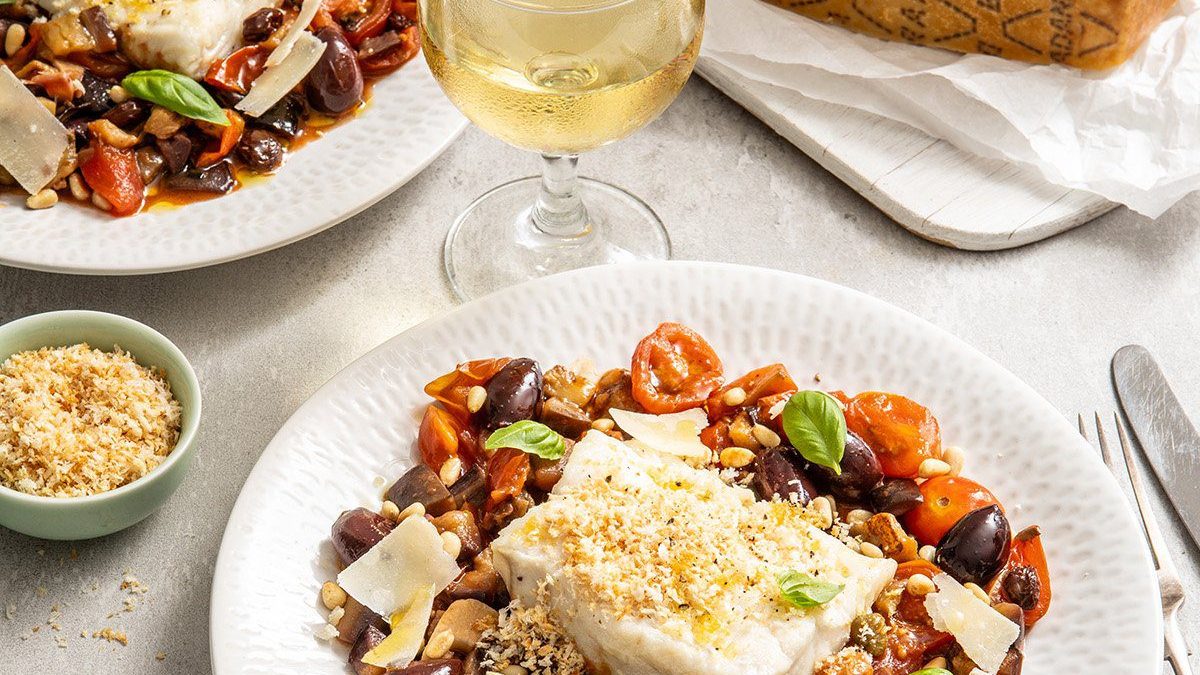
This hard, grainy, fruity cheese from northern Italy is the pride of the country, finding its way onto cheeseboards and into recipes across its 20 regions.
We take a closer look at how special Grana Padano is before sharing two light and fresh dishes that showcase the cheese’s incredible flavour (and nutritional values) with plenty of Italian flair.
Born in a monastery
The story begins around 1135, when Cistercian monks at the Chiaravalle Abbey near Milan needed a way to preserve the surplus milk of the fertile Po Valley. What they arrived at was a cheese built to last — and one that has barely changed since. The name says exactly what it is: grana for the grainy, crystalline texture, padano for the Po plain it comes from.
Four ingredients, nothing else
True excellence requires few ingredients: rennet, lysozyme, salt and the highest quality milk. The evening milk is left to cream overnight so the fat rises naturally, then blended with the morning milk in copper vats, heated to 31–33°C, and the curd broken down into rice-sized granules — the grana itself — before cooking at 53–56°C. The wheels are then brined for 27 days.
The scale is extraordinary. Roughly 15 litres of milk go into every kilo of finished cheese, and each vat holds around 1,000 litres. A single wheel weighs between 24 and 40kg.
The three ages
The consortium’s ageing bands make it unusually easy to know what you’re buying.
9–16 months is the everyday cheese — pale straw-coloured, delicate, ideal for grating.
Over 16 months deepens noticeably. The granular texture firms up, calcium lactate crystals begin to form, and the flavour turns full and pronounced without ever becoming piquant. This is the one for flans, soufflés and quiches, and for pasta, risotto and soups.
Riserva, over 20 months, is the connoisseur’s wheel. It earns a second fire-brand only after passing an extra quality inspection, and tastes of butter, hay and dried fruit — rich and full, yet still delicate. The crystals are pronounced, the flake unmistakably triangular. Pair it with dessert wines, fortified wines or full-bodied aged reds.
How to know it’s the real thing
Look for the PDO branding fired into the rind. Without those marks, it isn’t Grana Padano — it’s a generic grana-style cheese. Pre-grated packs are the weaker buy, because you lose both the visual proof of authenticity and any control over age and texture.
A nutritional heavyweight
This is where Grana Padano makes an unusually strong case for itself. It carries around 33g of protein and over 1,100mg of calcium per 100g. Just 30g holds the nutritional value of roughly half a litre of milk, and 50g delivers over 600mg of calcium — 60% of an adult’s daily requirement, or 50% of an adolescent’s.
It’s naturally lactose-free thanks to the production method and long ageing, so it suits a lactose-free diet, and it’s gluten-free too. Galactose content sits below 10mg per 100g. One more trick worth knowing: grated into pasta, rice, sauces, dressings or soups, it can stand in for salt.
Allergen note: lysozyme is derived from egg white, so the cheese isn’t suitable for anyone with an egg allergy.
Two dishes to show it off
Shaved courgette, lemon and Grana Padano salad
SERVES 4 · 15 MINUTES
Raw courgette is transformed by good cheese and an acidic dressing — this is the Italian trick worth stealing.
Slice 3 firm young courgettes into ribbons with a peeler and lay them on a platter. Whisk the juice and zest of a lemon with 4 tbsp extra virgin olive oil, a crushed garlic clove and plenty of black pepper, then pour over and leave for 10 minutes to soften. Shave over 60g of Grana Padano aged over 16 months using the same peeler, and scatter with 40g of toasted flaked almonds and torn mint.
Hold back on the salt — the cheese does that work. Best eaten within the hour, while the courgette still has snap.
Spring vegetable stracciatella with Grana Padano
SERVES 4 · 25 MINUTES
The Roman soup that turns a leftover rind into supper. Never throw the rind away.
Simmer 1.2 litres of good chicken or vegetable stock with a Grana Padano rind for 15 minutes, then remove the rind. Add 150g of asparagus tips and 150g of peas and cook for 3 minutes.
Beat 3 eggs with 50g of finely grated Grana Padano, a grating of nutmeg and a little lemon zest. Pour the mixture into the barely-simmering broth in a thin stream, stirring once, then leave for 30 seconds — it should set into soft ribbons rather than scrambling. Finish with more grated cheese and torn basil.
Light, protein-rich and on the table in under half an hour — and it makes the case for the cheese better than any cheeseboard.



Comments