
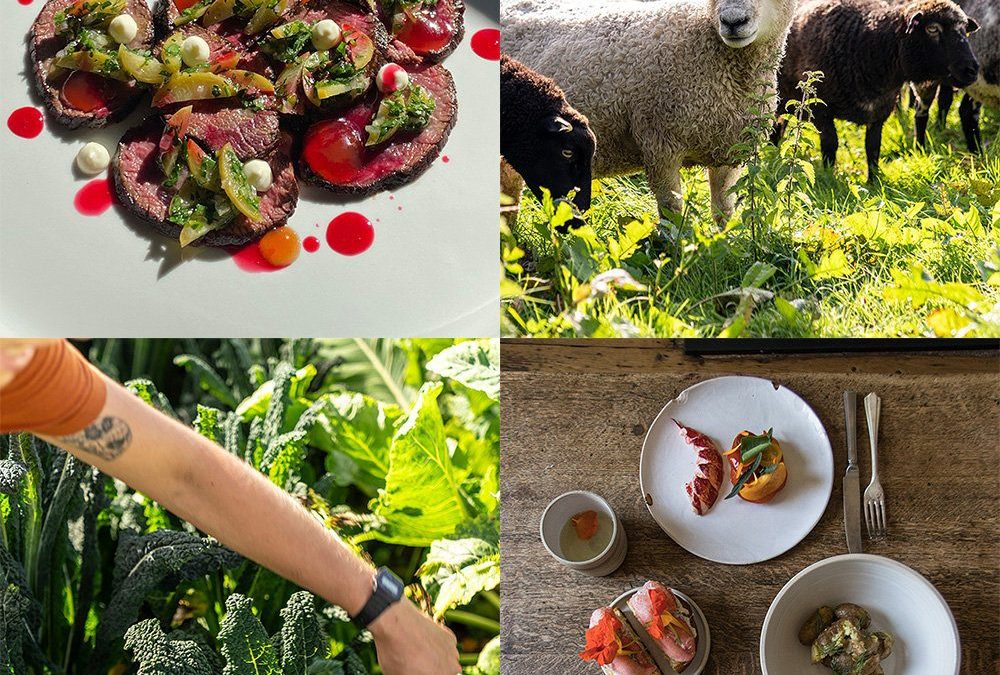
Seasonal, local and farm to table have long been buzzwords on restaurant menus, with chefs indicating quality through the provenance of ingredients. Recently, though, the distance between kitchen and farm has been closing.
Not metaphorically. Literally. A growing number of Britain’s most ambitious chefs are no longer simply buying from farmers; they are becoming them. They are taking on acreage, hiring growers, drawing up planting plans in January for menus they will write in August, and in some cases moving their entire operation out of town to sit closer to the soil. The kitchen garden has stopped being a decorative flourish by the car park and started being the reason the restaurant exists at all.
From sourcing to owning
The pioneer, in this country at least, is Simon Rogan, whose farm near Cartmel has supplied L’Enclume for years and turned a supply chain into a philosophy. What was once eccentric is now close to standard practice at the top end.
Merlin Labron-Johnson took the logic further. Having won a Michelin star for Osip on Bruton high street, he moved the whole restaurant out of town to a freehold site with its own land, and now sources almost everything within a five mile radius, with kitchen and front of house staff both on a gardening rota. Sam Buckley at Where The Light Gets In in Stockport works a network of nearby farms and growers so closely that there is no menu at all: you eat what arrived that morning. In Manchester, Higher Ground built its reputation partly on a dedicated market garden growing to its specifications. Artfarm’s Durslade estate in Somerset runs to a thousand acres of cattle, sheep, orchards, walled garden and vineyard, feeding restaurants and a farm shop on the same site.
The pattern repeats across Europe. Amsterdam’s De Kas is a working greenhouse with tables in it. Bolenius grows in its own kitchen garden. Copenhagen’s fine dining scene was built on a manifesto about the produce of a specific landscape, and its chefs have spent two decades proving the point.
Why now
Several forces have converged, and only one of them is idealism.
The first is fragility. The past few years have taught British restaurants that supply chains break. Brexit paperwork, pandemic disruption, energy costs, driver shortages and a collapse in seasonal labour have all made the weekly delivery a less certain thing than it once was. Growing even a portion of your own produce is a hedge. If you control it, nobody can fail to deliver it.
The second is differentiation, which matters more than chefs like to admit. When every menu in the country claims to be local and seasonal, the words stop meaning anything. Owning the farm converts a claim into a fact. It is proof rather than marketing, and diners have become sophisticated enough to tell the difference.
The third is Michelin. The Green Star, introduced in 2020, gave sustainable practice a formal place in the guide’s hierarchy for the first time, and ambitious kitchens responded exactly as you would expect. Where recognition goes, investment follows.
The fourth is flavour, and it may be the most interesting. Commercial growers select varieties for yield, uniformity and shelf life, because that is what the supply chain rewards. A chef choosing what to plant selects for taste alone. That means heritage tomatoes that would never survive a supermarket depot, herbs picked an hour before service, and vegetables harvested at a size and stage that suits a plate rather than a pallet. It is the single biggest culinary argument for the whole enterprise, and the one that most convinces sceptics after a mouthful.
The fifth is simply that the work has changed. A generation of chefs trained in high pressure city kitchens has decided it would rather be somewhere quieter, with better air and a reason to go outside. Farming is punishing in its own way, but it is a different punishment.
The catch
It would be dishonest to present this as an unambiguous success story.
Farming is capital intensive, weather dependent and structurally low margin. Very few restaurant farms make money as farms; they are subsidised by the restaurant, justified as marketing, quality control and staff development rather than as agriculture. That is a legitimate business decision, but it is not the same as proving that small scale local growing is economically viable, and the distinction gets blurred in the telling.
Scale is another honest limit. Even a well run restaurant farm typically supplies a minority of what the kitchen needs. Flour, dairy, fish, oil, coffee, wine and most protein still come from elsewhere. The best operators are candid about this. The weaker ones let a herb planter and a few raised beds do a great deal of narrative work.
Then there is climate. The same volatility that makes provenance feel urgent also makes growing riskier. A late frost, a wet spring or a drought does not care about your tasting menu, and a restaurant tied to its own harvest is exposed in a way that one with a wholesaler is not.
And there is the uncomfortable question of who this is for. Almost all of the restaurants leading this movement sit at the expensive end of the market. The chef with land is producing exceptional food for people who can afford a tasting menu, while the wider food system that feeds everyone else remains largely untouched. Growing your own is a solution available to a very small number of kitchens.
What it changes
Set the caveats aside, though, and something real is happening.
Menus are getting shorter and stranger, because a farm produces what it produces rather than what a chef would like to order. Waste is falling, because when you have grown something yourself you are far less willing to bin the leaves. Staff who spend a morning a week weeding understand the ingredient differently by service. And the seasons have started to mean something again in British restaurants, having spent decades flattened by air freight into a permanent, characterless summer.
The most convincing version of this is not the grand estate with a photogenic walled garden. It is the small restaurant with an acre, a grower on the payroll and a menu that changes because it has to. That is a harder thing to build than a supply relationship, and a much harder thing to fake.
Which may be the real point. Farm to table has spent twenty years as a phrase on a menu. Its next twenty will be spent proving whether anyone actually meant it.


Comments